Favourite temples 2: the temple of revenge in Sri Lanka


Continuing my occasional series about memorable temples I have visited – here’s something about the Temple of Devol (Seenigama Devalaya) off the Sri Lankan coast, which I encountered in 2018.


Just offshore from the coastal village of Seenigama in south-western Sri Lanka, you’ll find a temple consisting of two small buildings perched on top of a rocky little island.  The temple is devoted to an imperious-looking deity called Devol, who’s believed to look after the local fishermen and, it’s said, local truck drivers too.  But he’s more famous for being a god of revenge.  If someone has wronged you, you can travel to the island and make an offering to Devol in the hope that he’ll impose retribution on the culprit.


To get from the island from Seenigama’s beach, you have to travel in a flimsy-looking boat with an outboard motor.  It can take twenty or more people at a time, some of whom – not all – are given life-jackets.  When I got to the beach, I discovered that most of my fellow passengers were feisty old Sri Lankan ladies who boarded the boat by enthusiastically beetling up over its stern and sides and into its two rows of seats.  A little later, they transferred themselves from the boat to the island itself with a similar, impressive display of agility and sprightliness.  I couldn’t help but wonder if those elderly ladies were heading to the temple to call on Devol to wreak revenge on their enemies.


The boat-trip only took a minute or two.  The island quickly swelled up out of the sea ahead of us, the rocks at the waterline black, the higher rocks grey, and then these natural formations giving way to manmade walls of faded yellow with blue-painted arched crests along their tops.  The boat ended up bobbing and swiveling drunkenly in the surf next to some slimy boulders that, further up, transformed into stone steps.  Walking around the island in footwear isn’t allowed and I’d already removed my boots and stashed them in my bag – which was just as well, because to get from the boat and onto the boulders I needed to wade through a swash of seawater.


While I got up to the steps, I felt uncomfortably like Stephen Maturin, the landlubberly and accident-prone ship’s surgeon in Patrick O’Brian’s Master and Commander books, who “at one time or other… had contrived to fall between the boat that was carrying him and almost every class of ship and vessel in the Royal Navy.”  But I managed to negotiate the boulders, ascend the steps and get onto the temple grounds up-top without slipping, drenching and embarrassing myself.


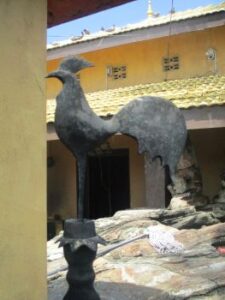
In addition to the buildings, the temple contains a small tiled yard, a clump of palm trees, a well, a small metal sculpture in the shape of a rooster and a tall concrete pole with spotlights attached.  The day I was there, many pigeons were perched on the golden-yellow roofs and flies were crawling in great profusions about the tiled ground.


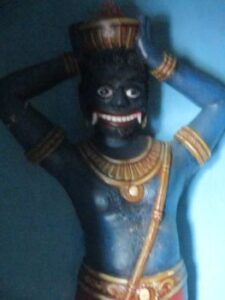
I found inside the smaller temple building a tall statue of Devol with a coppery red face and an impressively curly moustache.  His image is partially obscured by curtains, supposedly – I’ve read somewhere – to lessen the harmful effects of his wrath as it radiates out of him.


After taking a few photographs in that room, I turned around and stepped out of it again.  The moment my bare feet touched the moonstone at the threshold – which like all the horizontal surfaces here was wet and treacherous – I slipped spectacularly and landed with a great thud on my ‘jacksy’, as they say in Glasgow.  Thankfully, my bag, with my boots inside it, muffled the impact of the fall and possibly saved me from breaking my tail-bone.  It was embarrassing, however.  All the visitors in the yard outside promptly looked my way and enjoyed a quiet chuckle at my haplessness.


The larger temple building contained an altar on which, if you wish Devol to wreak revenge on someone, you present offerings of chilis, garlic and hot spices that, later, a priest grinds up in a ritual outside.  That’s right, that’s how it works here – to place a curse on the person who’s mistreated you, you need to contribute to the making of a chili paste.  Three deities lurk in alcoves behind and to the left and right of the altar.  The central one look fairly benign, but the other two are more sinister.  The left-hand deity wears a helmet and girdle made out of interlocking cobras while the right-hand one looks even more ghoulish, with a rictus grin and fangs protruding downwards from the ends of its long mouth.


Various travel blogs in which I’ve read about the temple have gone on in detail about how the visiting pilgrims, seemingly intoxicated by the idea of getting revenge on their persecutors, work themselves into states of ecstasy and hysteria.  But I saw none of that.  The crowd who’d come with me in the boat seemed very calm, composed and quietly respectful.  (Well, apart from their moment of mirth when I keeled over on that slippery moonstone).  As I’d said earlier, most of them were elderly local ladies.


It occurred to me afterwards that Devol has several roles – he’s a guardian of fishermen (and truck-drivers) as well as a bringer of revenge – and maybe the ladies had come with a more benign purpose.  Maybe they just wanted to pay their respects to Devol and ask him to look after their sons and husbands while they made their livings out on the waves or out on the roads.


Uncle Sam (Part 2)


© Universal Pictures / Amblin Entertainment


Continuing my tribute to the great New Zealand actor Sam Neill, who died on July 13th


Sam Neill got top billing alongside Laura Dern and Jeff Goldblum in Steven Spielberg’s Jurassic Park (1993), the highest-grossing movie of all time until James Cameron’s Titanic was released four years later.  While it was gratifying that Neill’s career get a boost from his involvement in such a blockbuster, I have to say I’m not  a great fan of it.  That’s probably because prior to seeing the film, I read the book it’s based upon, Michael Crichton’s Jurassic Park (1990), wherein the story and characters are darker, more complex and more interesting than Spielberg’s interpretation of them.


As Alan Grant, a palaeontologist asked to assess the titular theme park where, it’s planned, visitors will pay good money to gawk at dinosaurs that’ve been cloned back into life using bits of ancient DNA, Neill is inevitably – and literally – dwarfed by his co-stars, the dinosaurs that Spielberg’s special-effects team, headed Stan Winston, created using then-cutting-edge animatronics and computer-generated imagery.  Still, he invests Grant with enough quirks to make him memorable.


He’s sometimes curmudgeonly and not fond of children, even ones who like dinosaurs – see how he spooks one youngster with an account of how velociraptors killed their prey, or how he freaks out the grandchildren of park-owner John Hammond (Richard Attenborough) by pretending to get fried by an electric fence.  Paradoxically, he can be child-like himself.  When he first sees one of Hammond’s dinosaurs, his wonderment leaves him struggling for words and he almost faints.  And he shows juvenile delight when he encounters a triceratops, which he hails as “my favourite when I was a kid… the most beautiful thing I ever saw.”  (When I was a kid, the triceratops was my favourite dinosaur too.)


When Jurassic Park received a royal premiere in London, Neill found himself sitting between his 10-year-old son and Princess Diana.  According to Neill, his son got so worked up at the film’s scary bits that he started farting uncontrollably, and Neill became paranoid about what his royal neighbour would think when she smelled the fumes: “Princess Di is being exposed to the horrors of a little boy’s fart, but she’s going to think it’s me.  I am going to be subliminally blamed for my son’s crimes, and I don’t think she’ll talk to me afterwards.”  However, gallantly, the princess did speak to him later and ‘never mentioned’ the flatulence.  Jeff Goldlum commented drolly on Neill’s anecdote: “I’ve heard him tell that a couple of times and it’s just amazing the lengths that he will go to still blame the boy.”


Neill played Grant twice more, in the second sequel Jurassic Park III (2003), which I saw on TV and found pretty inconsequential; and the fifth one, Jurassic World Dominion (2022), which got lousy reviews and which I’m in no rush to see.


© Miramax / Buena Vista international / Jan Chapman Productions


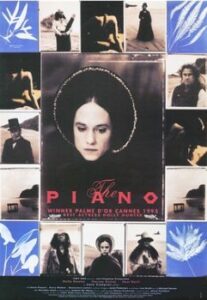
As well as being in 1993’s biggest blockbuster, Neill was in the same year’s biggest arthouse movie, Jane Campion’s The Piano.  He plays Alisdair Stewart, a settler in 19th century New Zealand who, via an arranged marriage, suddenly acquires a wife, the mute Ada (Holly Hunter).  He also acquires a piano, the playing of which is Ada’s only opportunity to express herself.  Predictably, Alister and Ada don’t enjoy a happy marriage and the piano is the catalyst for trouble.  It becomes the means by which Ada, unable to tolerate Alisdair’s sexual advances, instead discovers sensuality with a neighbouring settler, George Baines (Harvey Keitel), under the pretext of giving him piano lessons.


While Keitel’s character first seems weird and brutish, but gradually shows himself capable of tenderness and decency, Neill’s goes the other way – we initially have some sympathy for Alisdair, but he becomes a villain who propels the plot towards its climax of mutilation and attempted suicide (though, ultimately, it ends happily).  In his 2023 autobiography, Did I Ever Tell You This: A Memoir, Neill wrote of the film, “I don’t think I can overestimate how important The Piano is for me in hindsight.  It sits in my funny old CV like a medal on my chest.  It wasn’t my film.  It was Jane Campion’s.  I wasn’t the star of the film.  That was Holly Hunter.  But there is honour to be found in the second fiddle.  Or fourth.  No one notices you much, you don’t get nominated for things.  But you served.  I was there in an important feminist film.  I was there in the front line in an important New Zealand film.”


As many have noted, The Piano is an example of how Neill used his screen presence to generous effect.  He didn’t hog the limelight but gave his co-stars space to perform to their full potential.  This was especially so with his female co-stars.  While Neill reined himself in a little, they got the chance to bloom in their roles – not only Holly Hunter in The Piano, but Isabelle Adjani in Possession (1981), Nicole Kidman in Dead Calm (1989), and reportedly – I’ve unfortunately never seen it – Judy Davis in My Brilliant Career (1979).


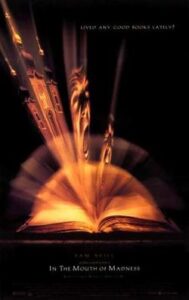
In 1995, Neill worked with cult American director John Carpenter and made the horror movie In the Mouth of Madness, which critics greeted unenthusiastically at the time but which, gradually, has been re-evaluated and is seen now as a misunderstood classic.  It features Neill as an insurance investigator called John Trent, who’s hired by a publishing company to track down its missing star author (Jurgen Prochnow).  The author’s name is Sutter Kane and though his initials, and massive sales, suggest he was inspired by Stephen King, his tales of cosmic horror and fearsome ancient beings called the ‘Old Ones’ indicate he’s based on the legendary Providence writer H.P. Lovecraft.  Trent’s investigations bring him into ever-stranger situations where he encounters characters and settings from Kane’s fiction.  It’s as if the writer is controlling what happens in reality – which is worrying, since his new novel concerns the end of the world.


© New Line Cinema


While I’m glad a movie involving Sam Neill, John Carpenter and H.P. Lovecraft has received some retrospective love, I’m afraid I agree with those unenthusiastic critics in 1995.  Like many of Carpenter’s later movies, there’s just too much going on in In the Mouth of Madness and you get the impression the director’s throwing everything at the wall in the hope some of it sticks.  That said, the movie has some memorable moments, such as a scene where Trent and a client discuss business in a restaurant, not noticing a mad axeman creating mayhem in the street outside their window.  Carpenter also stages a spooky sequence wherein a night-time cyclist keeps inexplicably reappearing in front of a cruising car – and keeps changing.


I prefer an earlier Neill-Carpenter collaboration, Memoirs of an Invisible Man (1992), an adaptation of H.F. Saint’s 1987 novel of the same name, itself inspired by H.G. Wells’s novel The Invisible Man (1897).  It’s a somewhat awkward film – the tension between the studio, Warner Bros, who wanted an out-and-out comedy, and the star, Chevy Chase, who wanted to show he could do ‘serious acting’, is palpable – but nonetheless I think it’s underrated.  I certainly enjoyed Memoirs of an Invisible Man more than director Carpenter did, who once said of it: “I really wanted to quit the business after that movie…  I don’t want to talk about why, but let’s just say there were personalities on that film.  He shall not be named who needs to be killed.  No, no, no, that’s terrible.  He needs to be set on fire…  No, no, no.  Anyway, it’s all fine.  I survived it.”  Presumably Carpenter was referring to Chase, who has a reputation for being, shall we say, difficult.  Even an invisible Chevy Chase was too much for him.


Carpenter certainly didn’t mean Neill, who played the film’s slightly James Mason-like villain.  “I love working with him,” the director said of Neill.  “He comes prepared.  He knows what he’s going to do.  He reacts to other actors who are there.  I mean, he’s just a dream come true.”


© Paramount Pictures / Golar Productions / Impact Pictures


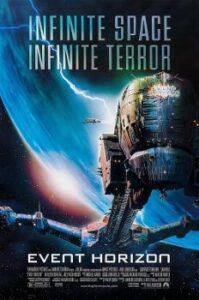
Another horror movie Neill made in the 1990s, which initially got savaged by the critics but was retrospectively reassessed and lauded as a classic, is Paul W. S. Anderson’s Event Horizon (1997).  Set in 2047, it’s about an experimental spaceship that’d disappeared during its maiden voyage inexplicably reappearing years later with no sign of its crew.  When a rescue mission, whose members include Neill, investigate, it becomes clear the ship’s hyperdrive system accidentally sent it into another dimension – a dimension known to religious folk as ‘hell’ – and back.  And it’s returned with something nasty on board.


Well, I’m sorry to be a misery-guts again, but I also agree with the 1997 reviews of Event Horizon and don’t see it as an unappreciated masterpiece.  It strikes me as a muddled mixture of Ridley Scott’s Alien (1979) and Clive Barker’s Hellraiser (1987), with that old chestnut of ‘characters being tormented by their innermost fears brought to life’ thrown in.  To be fair to Paul W. S. Anderson, the studio, Paramount Pictures, removed much footage from his original edit, believing it was too gory and horrific, and the finished product was not what he and scriptwriter Philip Eisner had envisioned.  Incidentally, as Neill’s character is Australian, he had him wear a uniform with an Australian flag-patch – but one where the Union-Jack part of it has been replaced by the Aboriginal flag.  Neill hoped that by 2047 a more tolerant, Pauline Hanson-free Australia would better honour its indigenous inhabitants.


By the start of the 21st century, and his sixth decade, Neill had become something of an institution and seemed the personification of the word ‘avuncular’.  A good example of this is in the Australian movie The Dish (2000), a gentle comedy in which he plays the boss of an Australian radio telescope that, in 1969, is landed with the job of relaying film-footage from the Apollo 11 moon-mission to the eagerly-awaiting world’s TV screens. This isn’t easy for Neill and his team as, first, they suffer a crippling power cut and then, on July 20th, the day of the landing, a violent storm threatens to blow their dish over.  Neill is reassuringly calm and reasonable throughout.  Thinking about the film now, I can’t recall any moment in it where he didn’t seem to be wearing a cardigan or puffing at a pipe.


© Madman Films / Piki Films / Defender Films


He’s somewhat less avuncular, but still loveable, in Hunt for the Wilderpeople (2016).  He plays Hector, a grumpy old misfit who takes to the New Zealand mountains with his chubby, juvenile-delinquent foster-kid Ricky (Julian Dennison) when the latter panics about being returned to state care.  They soon have police, social services, vigilantes and the media after them.  Along the way they encounter hardship, killer wild boars and a literally tinfoil-hat-wearing lunatic called Psycho Sam (Rhys Darby) but also form a genuine, father-son bond.  Director Taiki Waititi creates an affecting and funny movie but avoids easy laughs and cloying sentimentality.  Neill and Dennison’s characters take some hard knocks and their happy ending is hard won.


During the 21st century Neill also became a fixture on television – appearing in shows like The Tudors (2007), Crusoe (2008-9), Happy Town (2010), Alcatraz (2012), Peaky Blinders (2013-14), Old School (2014), Tutankhamun (2016), The Twelve (2022-25) and Apples Never Fall (2024) –  and on social media, where he regularly posted updates about Two Paddocks, his beloved farm and vineyard in New Zealand’s Central Otago wine region.  Famously, Neill named the animals on his farm after celebrities he knew in showbusiness, supposedly because it made him less inclined to eat them: “Well, you can’t eat a friend…  I’m not a vegetarian, but I have a ram called Jeff Goldblum.  You wouldn’t want to eat Jeff, would you?”


This led to some memorable moments as, for example, Neill posted, “MICHAEL FASSBENDER ASSAULTED!” – his rooster, named after Michael Fassbender, had had his tail-feathers torn out by a rogue dog.  Or a comment he made about Helena Bonham-Carter, one of his cows: “She’s had 16 calves now.  She’s up for it, if nothing else.”  Or a sad disclosure that Meryl Streep, a chicken, had been “…killed by a ferret recently.”  During Covid-19, his gentle and good-humoured updates about his farm and its whimsically-named inhabitants was an antidote to the stress and boredom of lockdown.  They certainly cheered me up more than, say , Gal Gadot and a bunch of her thespian pals crooning John Lennon’s Imagine on Instagram.


In a 2023 interview in the Guardian, Neill opined, “I’m not afraid to die but it would annoy me. Because I’d really like another decade or two, you know? We’ve built all these lovely terraces, we’ve got these olive trees and cypresses, and I want to be around to see it all mature. And I’ve got my lovely little grandchildren. I want to see them get big…  But as for the dying? I couldn’t care less.”  A lot of people would have loved to have got another decade or two of Sam Neill, and his acting talents, and his sense of fun.  But we should be grateful for what we did get.


© Universal Pictures / Amblin Entertainment

Uncle Sam (Part 1)


From wikipedia.org / © Sean Koo


Having just paid tribute to the centenarian Mel Brooks, I hadn’t intended to post another film-related entry so soon on this blog.  Sadly, however, Sam Neill, whom I admired both as an actor and as a person, passed away three days ago and I thought I should pen some words in honour of him too.


Neill’s passing was made even sadder by the fact he’d recently been declared cancer-free after a five-year battle against the disease.  Seemingly, his immune system was so weakened by the treatment he’d received that he fell prey to pneumonia.  Rima Te Wiata, Neill’s co-star in Hunt for the Wilderpeople (2016) told the New Zealand Herald: “It really sucks, actually… I think he would be like: ‘For goodness sake, I got over my cancer. And now look, now I get pneumonia. What next?'”


Though officially a New Zealander, Neill could also be called a Northern Irishman because in 1947 he was born in Omagh, county-town of County Tyrone (17 miles away from where I spent my childhood), to New Zealand and English parents.  He moved from there to Christchurch in 1954 and presumably, if he’d ever acquired a Northern Irish accent, he soon lost it.  Decades later, when he played the psychotic Belfast policeman Chester Campbell in the first two seasons of the TV show Peaky Blinders (2013-14), he asked two mates – Northern Irish actors Liam Neeson and James Nesbitt – for coaching so that he could produce a convincing ‘Norn Irn’ accent.


He also began life as ‘Nigel’, but by the age of 11 had taken to calling himself ‘Sam’.  When he started acting, he was glad he’d chosen the blokey ‘Sam’ over the slightly effete ‘Nigel’.  In an interview published recently in the Guardian, he commented, “If I’d stayed with Nigel Neill, I don’t think I would have had a film career.”  He’d obviously never encountered the great screenwriter Nigel Kneale, whose creations included the Quatermass films and TV dramas.


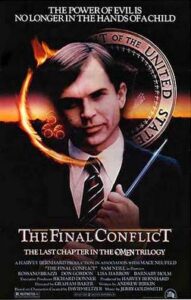
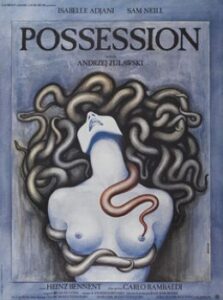
Though he’d done film and TV work throughout the 1970s, including Roger Donaldson’s thriller Sleeping Dogs (1977), described on its Wikipedia page as “the first feature-length 35 mm film produced entirely in New Zealand”, Neill first came to my attention in 1981, when I was a horror-film-obsessed teenager and when he appeared in two fairly high-profile horror films, Graham Baker’s Omen III: The Final Conflict and Andrzej Żuławski’s Possession.  I read about them in film magazines like Starburst and Fangoria, though I was too young to see them in a cinema because in the UK they were given ‘X’ certificates, meaning only people aged 18 and over could see them.  In the case of Possession, I didn’t even have a chance to see it later on video for it ended up on the Britain’s infamous (and idiotic) ‘video nasties’ list, deemed likely to ‘deprave or corrupt’ its viewers and thus banned from home viewing.


© Mace Neufeld Productions / 20th Century Fox


Omen III: The Final Conflict was the third in the trilogy that’d started with Richard Donner’s The Omen (1976) and continued with Don Taylor’s DamienOmen II (1978) and that told the tale of Damien Thorn, the son of Satan and the Antichrist who, according to Biblical prophecies, will rise to power in end times.  Unlike the earlier two movies, where Damien is depicted as a kid (first played by Harvey Spender Stephens, then Jonathan Scott-Taylor), he’s now an adult.  Portrayed by Neill, he’s the powerful CEO of Thorn Industries and soon into the film also becomes US ambassador to Britain, a position from which he hopes to launch his biggest project yet – the thwarting of the Second Coming of Christ.


As Damien, Neill is suave enough to be convincing as a powerful operator in purely human affairs, one who can rub shoulders with top people in top places and get what he wants; whilst also having a sinisterness and darkness that makes you accept him as the same, infernal creature he was in the earlier films (especially the disturbingly baleful Spender Stephens in the first Omen).  Alas, Neill is the only thing of value in the film.  Coming after the original, which was very enjoyable hokum, and the second film, which at least had its moments, The Final Countdown is a damp squib.  Unlike his predecessors Donner and Taylor, Graham Baker doesn’t have the directing chops to properly mount the Omen films’ main attractions – the set-piece ‘accidents’, elaborate, supernaturally-engineered and inevitably fatal, that bump off anyone who gets in Damien’s way.  That said, the scene early on where the previous American ambassador commits ‘suicide’ and conveniently creates a job opening for him, is agreeably splattery.


A far less conventional horror film, and a far better one, is the same year’s Possession.  Though it defies all description, you could say it was a particularly traumatic and traumatising break-up movie…  Or a brooding parable about the Cold War (it was filmed in West Berlin)…  Or a psychological thriller involving doppelgangers…  Or a body-horror film wherein a woman makes repeated love to a vilely tentacled, half-human, half-squid creature…  Or an espionage thriller leading to an apocalyptic World War III finale.


Director Andrzej Żuławski – himself suffering from depression after recently being expelled from his native Poland – put Neill and his co-star Isabelle Adjani through the wringer during the film’s making.  Neill remarked in 2021 that he ‘escaped’ from the movie with his ‘sanity barely intact’.  Adjani suffered even more, though, and supposedly needed a couple of years to get over the experience.  That’s understandable when, for instance, you see the berserk intensity of the now-legendary sequence where she suffers a miscarriage in a subway corridor.  Actually, a young Gaspar Noé must have been highly impressed by that sequence because he basically got Sofia Boutella to recreate it in his 2018 movie Climax.


© Gaumont Distribution


Things were looking up for Neill’s career in 1983, when he played the title role in Reilly, Ace of Spies, a 12-part TV series dramatizing the life of real-life superspy Sidney Reilly during the first quarter of the 20th century.  Reilly was scripted by Troy Kennedy Martin and directed by Jim Goddard and Martin Campbell and Campbell, a fellow Kiwi, would later direct two James Bond movies, Goldeneye (1995) and Casino Royale (2006).  In fact, for a time in the mid-1980s it looked like Neill was in with a shout of becoming the next James Bond.  (It makes sense – there have been Scottish, Australian, Welsh and Irish Bonds, so why not a New Zealand one?)


In the Guardian interview I mentioned earlier, he was asked about the Bond role.  He said he would have accepted it if it’d been offered to him, but added: “I’m also aware that I wouldn’t have enjoyed my life so much if I was an ex-Bond. That’s what people would say when I went for my morning coffee. ‘Look – it’s what’s-his-name, who used to be James Bond?’ ‘Yeah, he was the one I never really liked.’”


In 1989 he had a good role in Philip Noyce’s Dead Calm, a maritime thriller / horror movie that conveys both the claustrophobia of being at sea – you’re stuck in the confined space of a boat – and the agoraphobia of it – you’re out on a vast, empty mass of water, far from civilisation and help.  Neil and Nicole Kidman (in her seventh, and breakout, film role) play a couple who, while yachting, discover a sinking schooner.  They pick up one survivor (Billy Zane) who – surprise! – turns out to be a crazed killer.


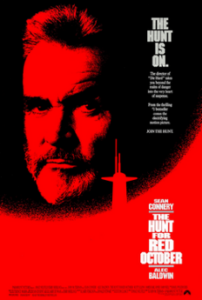
Still, I had the impression that during the late 1980s Neil’s moment had passed and he was destined to spend his remaining career in movies’ supporting casts as a reliable character actor.  This was suggested, for example, by his role in 1990’s The Hunt for Red October, where he gets fourth-place billing after Sean Connery, Alec Baldwin and Scott Glenn.  He plays the second-in-command to Connery’s Captain Marko Ramius, and a participant in a plot whereby the only submarine-commander in the Soviet fleet with a Scottish accent, and his officers, commandeer a super-submarine called Red October and attempt to defect with it to the West.  When Neill’s character starts waxing lyrically to Connery about the rabbit farm he plans to start up after they reach America, you know he’s going to get killed before the end.


© Mace Neufeld Productions / Paramount Productions


However, then, Neill’s fortunes took an upswing – because Steven Spielberg and blockbuster-dom came knocking.


To be continued…

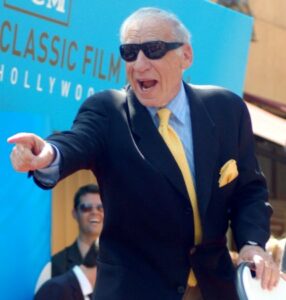
The 100-year-old Mel


From wikipedia.org / © Angela George


Last week saw much hype and noise about the United States of America celebrating its 250th birthday.  Under the leadership of Donald Trump, the USA marked the 250th anniversary of its independence from the British by holding a Great American State Fair on Washington DC’s National Mall.  This featured empty booths, cancelled musical performances, racist flags, power outages, collapsing roofs and a plywood model of the victory arch Trump wants to build on the Potomac that cracked, crumbled and oozed yellow gunk.  How odd that hardly anyone wanted to go to it.


In other moves to celebrate America’s 250th Independence Day, Trump refurbished the Lincoln Memorial’s Reflecting Pool, also in Washington DC, so that its water would shine a patriotic blue, though it immediately shone a less patriotic green thanks to a sudden and unforeseen algae bloom.  He also tried to extend the USA team’s run in the 2026 Football World Cup by arm-twisting Gianni Infantino and FIFA into breaking the sport’s red-card rules so that a key American player could play in the team’s next game – which they lost, courtesy of a 4-1 drubbing by Belgium, causing their exit from the competition.


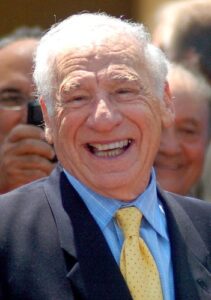
The sound and fury about the 250th anniversary of American independence, and the Trump-esque shenanigans accompanying it, have obscured the fact that, one week earlier, the USA witnessed another important three-digit birthday.  June 28th saw the 100th birthday of the legendary American filmmaker, comedian and general funnyman Mel Brooks.  By the time he turned his hand to making movies in the late 1960s, Brooks already had impressive comic credentials – devising the famed 2000-Year-Old Man comedy sketch with Carl Reiner, for instance, or creating the classic spy-comedy TV show Get Smart (1965-70) with Buck Henry.  But it’s fair to say his films are the body of work for which he’s most beloved.


Like much of the comedy I experienced from an early age – the CarryOn movies, or those starring Abbott and Costello, or the telly career of Ronnie Corbett – I’ve had a complicated and changing relationship with the oeuvre of Mel Brooks.  As a youngster, I thought it was brilliant.  As a young adult, who took himself much too seriously, I dismissed it – certainly, the later films Brooks made – as crass, cringeworthy guff.  Now, in my old age, I can find pleasure in the entirety of Brooks’s canon and appreciate the artistry displayed in even what are, by general consensus, his lesser efforts.  A bad joke might provoke a groan rather than a laugh, but to engineer that groan you still need a certain, warped skill.


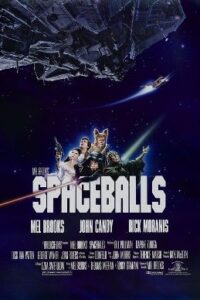
I think I passed from my youthful period of Brooks-disdain to my more mature period of Brooks-admiration in the 1990s.  This was when I was attempting to woo (with a total lack of success) a lady from New York whom I considered, for a while, the coolest thing on earth.  We were chatting one evening about our favourite films and the object of my affections suddenly astounded me by saying she was a huge fan of…  No, not Jean-Pierre Melville’s Le Samourai (1967), or Terence Mallick’s Badlands (1973), or Jim Jarmusch’s Mystery Train (1989), but…  Mel Brooks’s Spaceballs (1987).


From wikipedia.org / © Metro-Goldwyn-Mayer / Brooksfilms


“Seriously?” I spluttered.  I’d seen this science-fiction / Star Wars piss-take shortly after its release and thought it was dreadful.  But, patiently, the lady explained to me the sociological depth and cleverness of some of Spaceballs’ jokes that I’d missed – for example, when Bill Pullman and John Candy rescue the princess (Daphne Zuniga) and Pullman remarks, “That’s all we needed…  A Jewish princess!”  I had to concede there was more to Brooks’s humour than I’d thought.


So, I had my moment of epiphany.  I decided, to misquote a line in The Producers, “Don’t be stupid, be a smarty / Come and join the Mel Brooks party.”


Anyway, it’s a fortnight late for the great man’s 100th, but here is a belated guide to the funniest bits, in my opinion, of his movies.  There’s no mention of The Twelve Chairs (1970) and Life Stinks (1991) because I haven’t seen those two.


L.S.D. gets auditioned in The Producers (1967)

The movie that put Brooks on the cinematic map, The Producers has had quite an afterlife, becoming a successful Broadway musical that, in 2005, was turned into a film itself.  For me, its highlight isn’t the famous song-and-dance number Springtime for Hitler that’s the centrepiece of the show that impresario Zero Mostel and accountant Gene Wilder stage in the hope it’ll be a massive flop (allowing them to make a fortune from the shares they’ve sold in it).  No, the highlight comes earlier.


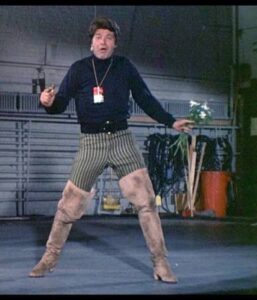
That’s when hippy Lorenzo St. DuBois – L.S.D. to his friends – stumbles into the show’s auditions by mistake and performs, with his female guitar / keyboards / sax backing band, a funny-terrible number called Love Power.   (“And I give a flower to the big fat cop / He takes his glove and he beats me up!”)  Played by Dick Shawn with thigh-high furry boots and a Campbell’s soup-can hanging on a chain around his neck, the hapless L.S.D. is hilarious – and the sequence reaches a perfect conclusion when Mostel bellows ecstatically, “THAT’S OUR HITLER!”


From instagram.com / (c) Embassy Pictures


The campfire scene in Blazing Saddles (1974)

If I was more sophisticated, I’d nominate as the funniest moments in Brook’s smash-hit comedy-western the scenes where he skewers the residents of frontier town Rock Ridge for their bone-headed racism.  (“You’ve got to remember that these are just simple farmers.  These are people of the land.  The common clay of the new West. You know…  morons.”)  However…  I’m nominating instead the sequence in Blazing Saddles where Slim Pickens’s men sit around a campfire and stuff themselves with traditional cowboy fare – beans – with flatulent results.


I first saw Blazing Saddles when it played on a big screen in the assembly hall of my school as one of the movies chosen for the school’s Film Club.  When the farting began, the teenaged audience, including myself, laughed like drains.  We were still roaring our heads off minutes after the sequence finished.  No other film shown during the several years I was a member of that Film Club – not Alfred Hitchcock’s Psycho (1960), not Nicolas Roeg’s Don’t Look Now (1973), not Ridley Scott’s Alien (1979) – provoked so tumultuous a reaction.  I’m not proud.


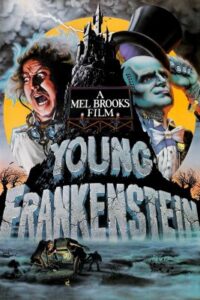
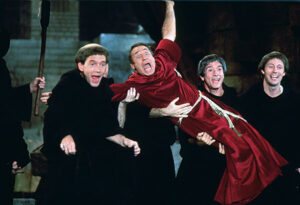
The monster meets the blind hermit in Young Frankenstein (1974)

The most genuinely affectionate of Brooks’s genre parodies, Young Frankenstein pokes fun at the black-and-white Frankenstein movies made by Universal Pictures in the 1930s.  My favourite part of it is when Brooks sends up the sequence in Bride of Frankenstein (1936) where the Frankenstein monster (Boris Karloff) is touchingly but briefly befriended by a lonely blind hermit (O.P. Heggie) who’s unaware of his monstrousness.  Here, the well-meaning but, well, blind hermit (Gene Hackman) accidentally and repeatedly scalds and burns the unfortunate monster (Peter Boyle) whilst trying to offer him broth, cigars, etc., until the latter flees from his cottage in terror.  Despite the gleeful bad taste of the gags, the Young Frankenstein sequence retains some of the sweetness and sadness of the Bride of Frankenstein one.  It also makes you wish Gene Hackman had played more comedy roles.


From wikipedia.org / © Gruskoff / Venture Films / 20th Century Fox


The boardroom table in Silent Movie (1976)

This was another movie shown at my school’s Film Club and another sequence that sent us – uncivilised little oiks that we were at the time – into paroxysms of laughter.  Evil corporation Engulf & Devour intends to take over the studio of filmmaker Mel Funn (Brooks) but that won’t happen if the new movie Funn is making becomes a hit.  Engulf & Devour’s board of executives hatch a fiendish plan to sabotage Funn and his movie – they’ll send sultry nightclub singer Vilma Kaplan (Bernadette Peters) to seduce, then dump Funn and re-kindle the massive alcohol problem he had previously.  When a picture of Vilma is unveiled to the executives, sitting around the boardroom table, they’re so impressed that the table rises by several inches.


The line Funn / Brooks inspires when Vilma does dump him, and he goes on a massive bender to drown his sorrows – “He is truly the lord of the winos!” – is pretty funny too.


The orchestra in High Anxiety (1977)

Brooks’s next film takes fond aim at the thriller movies of Alfred Hitchcock.  Its hero, Dr Richard Harpo Thorndyke, again played by Brooks himself, suffers from the titular disorder, the vertigo-like ‘high anxiety’.  While travelling in the back of a car, Thorndyke / Brooks suffers a moment of ominous foreboding, which is accompanied by an equally ominous swell of Bernard Herrmann-like orchestral music – the sort that Hitchcock liked to insert into his films to augment the mood.  This being a Brooks film, though, Thorndyke’s car then passes a bus that contains, as passengers, the orchestra playing the music.


Yes, this is the second time Brooks has used that gag.  It originally appeared in Blazing Saddles and involved the Count Basie Orchestra performing in the desert,  But the orchestra-on-a-bus joke in High Anxiety works better, I think.


The Spanish Inquisition in History of the World, Part I (1981)

A truly hit-and-miss collection of gags and sketches, History of the World, Part 1 depicts five chapters in world history from the Stone Age to the French Revolution.  Its undisputed highlight is a segment about the Spanish Inquisition.  This features Brooks as Torquemada – his victims are warned not to try to talk him out of torturing them because, “You can’t Torquemada anything!” – and an elaborate Busby Berkeley-like song-and-dance number in a torture chamber which, with its exuberant bad taste, is as impressive as Springtime for Hitler in The Producers.


© Brooksfilms / 20th Century Fox


Snotty’s line in Spaceballs (1987)

Spaceballs spoofs Star Wars (1977) but also contains some elaborate send-ups of Planet of the Apes (1968) and Alien (1979) – the latter even drafts in John Hurt to reprise his role as the unfortunate Kane.  But the funniest, or groan-iest, bit in it for me is a simple pun.  A Scottish character called Snotty (Jeff MacGregor), obviously based on Scotty from Star Trek (1966-69), is in a control room flicking a series of switches.  “Lock One!” he shouts.  “Lock Two!  Lock Three!  Loch Lomond!”


The abbot in Robin Hood: Men in Tights (1993)

You have to be a connoisseur of long-ago comedy double-acts to appreciate my favourite joke in Robin Hood: Men in Tights, Brooks’ irreverent take on the then-recent and hugely-successful Robin Hood: Prince of Thieves (1991).  An abbot (Dick Van Patten) is walking in his finery outside his monastery and enjoying the adulation of the local population.  Then a guy who looks and sounds suspiciously like Lou Costello yells at him, “Hey, Abbott!”  Van Patten grumbles, “I hate that guy.”


Dracula tries to control Mina’s mind in Dracula: Dead and Loving It (1995)

I don’t hold it against Brooks’s Dracula: Dead and Loving It, which stars Leslie Neilson as the legendary vampire count, that it isn’t great.  After all, there have been many attempts over the years to spoof vampire films and hardly any of them have been funny – see Roman Polanski’s Dance of the Vampires (1967) or Stan Dragoti’s Love at First Bite (1977).  In fact, it wasn’t until Jermaine Clement and Taika Waititi’s What We Do in the Shadows (2014) that I encountered a vampire-movie parody that made me laugh.


However, Dracula: Dead and Loving It has one funny part where, from a distance, Dracula / Neilson exerts his willpower over the bitten and partly vampirised Mina (Amy Yasbeck) and tries to summon her: “Mina…  Open your eyes…  Arise…  Come to the door…”  The operation goes less smoothly when the mind-controlling vampire discovers there’s a confusing closet door in the way, and a hazardous footstool, and an inconvenient maidservant who’s also picking up his telepathic instructions: “Mina…  You are in the closet.  Open the door and come out…  Watch out for the footstool…  Stand up…  Not you, sit…  No, you sit…  You stand…”


And just before I finish, some praise is due for Brooks as a producer too.  He’s the man who oversaw both David Lynch’s The Elephant Man (1980) and David Cronenberg’s The Fly (1986).


From wikipedia.org / © Angela George

It’s the hope that kills you


The footballing World Cup currently taking place in Canada, Mexico and some other place – oh yes, the USA – has now entered its second stage.  And guess what?  A certain country took part in the first stage but failed to qualify for the second one, just as it qualified for eight previous World Cups and didn’t make it to the second round of those competitions either.  In fact, it’s earned itself the unenviable record of being the most-useless-at-getting-to-the-second-round-of-the-World-Cup country ever.  Which hapless nation could this be?


Here’s a clue: “Yes sir, I can boogie…


I had a fortnight off work during the second half of June and spent that time in Scotland, in the Borders town of Peebles, where my family have lived for nearly 50 years after relocating from Northern Ireland in 1977.  My fortnight in Scotland coincided with the Scottish men’s team playing their second and third games of the World Cup, which they’d qualified for in November last year.  Well, I thought beforehand, I’ll be in Scotland in time to see if, finally, they can beat the jinx that’s stopped them from getting past the competition’s initial stage in 1954, 1958, 1974, 1978, 1982, 1986, 1990 and 1998.  And this time, with so many countries participating in the 2026 competition, surely it’ll be easy to get into that elusive second stage?  Surely they’ll beat the curse at last?


Thus, I braced myself for the Scottish World Cup 2026 experience, thinking of a lyric from the Eagles’ Hotel California: “This could be heaven or this could be hell.”


Guess which one it turned out to be.


When I arrived in Scotland on June 17th, the national team had already secured three points from their first World Cup game.  It had defeated by one goal to nil the footballing colossus that is… Haiti.  Actually, given Scotland’s history of embarrassing scores against minor footballing nations they were expected to beat, such as Iran in 1978 and Costa Rica in 1990, the win over Haiti felt like the clearing of an important psychological hurdle.  Now Scotland  needed just one more point to be sure of getting through to the second round.  As I traversed the streets of Peebles, folk around me were cautiously positive.  There was a certain sense of optimism.  Hope was definitely in the air…


But as older, wiser heads who’d experienced countless Scottish World Cup agonies in the 20th century would inevitably muse: “It’s the hope that kills you.”


June 19th saw Scotland’s second World Cup game, against Morocco.  By now, like humidity in the air triggering a spectacular thunder-and-lightning storm, that pervasive sense of hope had transformed into full-scale mass euphoria.  Mind you, I was slightly less euphoric, remembering Scotland’s last game in the last World Cup they qualified for, in France in 1998, which was against Morocco too.  Back then, Morocco had humped them three-nothing.


I watched the game in the social building of Peebles Rugby Club, where for once the crowd contained more fans of the round ball than fans of the oval one.  I’d never seen the place as wild as it was during the build-up to the game – people were yelling, singing, dancing on tables, waving glow sticks like demented cheerleaders.  In fact, there was so much merry-making and hullabaloo that most folk didn’t even notice when the first whistle blew and the match kicked off.  They also didn’t notice when two minutes later Morocco penetrated Scotland’s somnolent defence and knocked in an embarrassingly early goal.  There was some remarkable sobering-up done when the revellers finally focused their gaze on the Rugby Club’s TV screens and realised,  one goal down already – how the f*ck did that happen?


To be fair, Morocco didn’t look much more accomplished than Scotland, certainly not during the second half.  But the North Africans hung onto their slender lead for the next 90-odd minutes and the game ended one-nil to them and with Scotland acquiring zero points.  If only the team had been awake from the very start and denied Morocco that early goal.  They’d have scraped a nil-nil draw, got a point, qualified for the second round and made history.  I tried to console myself with the thought that as it was a three-nil defeat against Morocco in 1998, and only a one-nil defeat in 2026, this marked a 66% improvement on Scotland’s part.  Right?


The next day, June 18th, was the biggest day in Peebles’ annual Beltane festival.  Among other things, there was a parade of floats, bands and people in fancy dress along the town’s high street.  Many of the revellers were in the regalia of the Tartan Army, the Scottish football team’s travelling support – one guy in such attire was even riding a penny farthing.


Yet an unhappy sense of reality about Scotland’s World Cup prospects was tangible now.  Some of the bands were still dutifully playing Yes Sir, I Can Boogie (1977) by the Spanish disco duo Baccara, which has been the Tartan Army’s favourite anthem since 2020.  However, Langholm Town Band definitely had their finger on the pulse when they marched by me playing Ally’s Tartan Army, which was Scotland’s World Cup song in Argentina in 1978 and whose lyrics go, “We’re on the march with Ally’s army / We’re going to the Argentine / And we’ll really shake them up / When we win the World Cup / Cos Scotland are the greatest football team.”


Ally’s Tartan Army serves as a painful reminder of what happened during Scotland’s World Cup campaign in 1978.  The Scotland manager then, Ally MacLeod, was breezily optimistic about his team’s chances of winning the World Cup; his optimism was amplified by Scotland’s sporting press; the whole nation drank the Kool-Aid and believed their team only had to turn up in Argentina to lift the trophy…  And when Scotland were knocked out in the first round, it was seen as a national disaster and humiliation.  For years afterwards, the Scots suffered from P.A.S.D., i.e., Post-Ally Stress Disorder.


Scotland’s final first-round game was against Brazil on June 24th.  The Scottish World Cup record against Brazil had been woeful.  In the 1982 competition in Spain, Brazil beat them four-one, a cruel result considering that Scotland went one-nil up after 17 minutes, courtesy of a goal by David Narey.  (Big-chinned English football commentator Jimmy Hill earned himself the lasting hatred of Scotland fans by dismissing Narey’s goal as a ‘toe-poke’.)  A rematch at the 1990 World Cup saw Brazil beat them one-nil and caused Scotland’s elimination from the tournament.  Despite this, I heard slivers of optimism in people’s conversations: “We only need a draw… One point, that’s all…  And Brazil…  They’re not the great team they once were…  They’ve been disappointing so far…”


Yes, it’s the hope that kills you.


I watched the game at my brother’s house, where the audience included my nephew and his girlfriend, who hadn’t even been born when Scotland last played in a World Cup.  Brazil knocked the ball three times into Scotland’s goal – actually four times, but one of the goals was disallowed – without Scotland even achieving what the late Jimmy Hill would describe as a ‘toe-poke’ in return.  Afterwards, I said to my nephew and his partner something along the lines of, “Welcome to us old folk’s world – one of Scottish World Cup misery.”


Even then, it wasn’t absolutely certain that Scotland was out of the World Cup.  So many countries were involved in this competition, and the rules for making progress in it were so complex, that they still had a chance.  Some of the best-placed teams with three points would go through to Round Two.  Scotland might be one of the lucky ones if certain results went certain ways.  By June 27th, though, it was clear the results hadn’t gone the right way and Scotland were taking their ninth World Cup early bath.


Yes, it’s the hope that…  Oh, shut up.


If nothing else, the Tartan Army showed yet again that they’re one of the best sets of football fans in the world.  Despite the hassle of entering Donald Trump’s increasingly authoritarian USA, and the excruciating price of match tickets, transport, refreshments and everything else in a World Cup orchestrated by the rip-off maestro and evil Mekon Gianni Infantino, head of FIFA, they won American hearts and minds by supporting their team with good humour and self-deprecation and avoiding any nationalistic preening or belligerence.  And, along the way, they had a hell of a party.


The citizens of Boston, where they played their first two games, were particularly impressed.  They didn’t even mind the Tartan Army’s custom of plonking traffic cones on the heads of their municipal statues.  The day after the Haiti victory in this, the home city of the Irish-American diaspora, at a downtown Irish pub called Henessey’s Bar, Scotland fans managed the exceptional feat of drinking three times more beer than is normally sold on St Patrick’s Day.  “We’ve been here for over 30 years and we’ve never seen anything like it,” marvelled the pub’s boss.  Even the New York Times was moved to publish a feature about the Boston-Tartan Army love affair.


Those fans were merely enjoying the Scotland World Cup experience, and squeezing in as much hectic partying, while it lasted.  Because, as 2026 proves for the umpteenth time, the Scotland World Cup experience never lasts for long.


Leave a light on


From wikipedia.org / © Mirrorme


Three days ago – June 23rd – marked ten years since the electorate of the United Kingdom voted on whether or not their country should leave the European Union.  And two days ago – June 24th – marked ten years since the result of that referendum was announced.  I remember switching on the TV that morning a decade ago and seeing Andrew Neil, who looked and sounded like he’d just been hit over the head with a shovel, reporting on the BBC that against all expectations a narrow majority of the UK’s population had voted for ‘Brexit’, i.e., for Britain exiting the EU.  51.9% had voted to leave and 48.1% had voted to remain.


Brexit’s impact on the UK since then, to anyone who isn’t a head-in-the-sand Brexiter, has been shite.  Writing on the BBC website recently, Fasial Islam cited findings by the National Bureau of Economic Research.  The consensus was that “the UK economy is smaller now than it would have been based on the trajectory it was on in 2016…  The numbers range from about 3% to 8%…. These calculations are based on modelling how a UK still within the EU could have been expected to perform economically had it still experienced the pandemic and the 2022 energy shock but not Brexit…  The most recent study by the NBER takes account of population growth, and says the UK lost 6-8% of per capita output.”


The result has been a country strapped for cash.  Which, in turn, has helped fuel the visceral hatred directed towards Keir Starmer’s Labour government since it was elected to power with a huge parliamentary majority in July 2024.  People voted for Labour desperate to see a respite from the austerity they’d suffered under the Conservatives.  Yet Starmer and co. were obsessed with hoarding their pennies and served up more of the same.  They refused to scrap the two-child benefit cap.  They went after the universal winter fuel payment.  They tried to cut incapacity benefits.  And when, following outcries, they backtracked or partially backtracked on these policies, they made themselves look incredibly weak.


Yet, despite everything, Britain’s economy is still ranked by the IMF as the fifth biggest in the world, so someone must be making money there post-Brexit.  Presumably ones with large, offshore bank accounts and home addresses in Dubai.  Certainly not the average British citizen.


Brexit also cut the UK off from Europe at a time when it desperately needed to be part of a larger bloc for its economic and military security.  In geopolitical terms, the country couldn’t have picked a worse time to pull up the drawbridge and retreat in on itself.  In the east, Vladimir Putin has spent four years trying to subjugate Ukraine and, heaven forbid, if he has his evil way there he’ll have designs on more of Europe.  In the west, Donald Trump has taken a wrecking ball to the military alliances, trade protocols and diplomatic norms Britain has relied on for stability and prosperity over the past 80 years.  The amount of groveling Starmer has done to Trump, the modern-day Caligula, in the hope of currying at least a little of his favour testifies to the enfeebled place Britain is nowadays.


Brexit has generated huge amounts of political instability.  Successive prime ministers struggled to negotiate to leave the EU on terms that satisfied the gibbering hardliners of the far right and to generally surf the waves of chaos the thing had created.  In fact, we’ve had half-a-dozen prime ministers in a decade: the overconfident David Cameron, who allowed the referendum in the first place; the hapless Teresa May; the unspeakable Boris Johnson; the catastrophic but mercifully short-lived Liz Truss; the inconsequential Rishi Sunak; and the tone-deaf and charisma-free Starmer.  We’re about to get a seventh, now that Starmer has just announced his resignation and the poisoned chalice, sorry, the crown seems there for Andy Burnham’s taking.


So, seven British prime ministers in just over a decade.  That’s an astonishing reflection of the political shitshow the UK has become, especially when you consider there were seven prime ministers during the 46 years prior to Cameron: Harold Wilson, Ted Heath, Jim Callaghan, Margaret Thatcher, John Major, Tony Blair and Gordon Brown.


While multiple prime ministers have crashed and burned since 2016, Nigel Farage, the main architect of the Brexit fiasco, has prospered.  He’s slithered with serpentine ease from the United Kingdom Independence Party to the Brexit Party and, most recently, to Reform UK, which he runs as a limited company, owning 53% of its shares.  Making an outrageous race-baiting statement here – and hiding under a rock when that statement provokes violence on the streets – and accepting a dodgy five-million-pound ‘gift’ from a Thailand-based cryptocurrency investor there, Farage is the most despicable figure in British politics today.


Farage certainly knows how to divert blame.  His championing of Brexit may have led to economic and social misery for the British public but he’s convinced many people that it’s not his or Brexit’s fault, but that of immigrants and asylum-seekers and the ‘establishment’.  How Farage manages to keep a straight face when he – a son of a stockbroker, pupil at Dulwich College and one-time commodities trader in the City of London – rails about that establishment, I’ll never know.  His policies of deflection and scapegoating have won him so much support that he’s in with a good shout of winning the next election and becoming Britain’s eighth prime minister since 2016.


A Farage government would be ruinous for Britain.  No doubt it’d exhibit all the malignancies of the regime currently destroying the USA under Trump, whom he greatly admires: authoritarianism, racism, censorship, misinformation, corruption, cronyism, pseudoscience, climate-change denial, incompetence, general ignorance and much sucking up to Putin.


From pixabay.org / © Stux


Finally, you may have noticed the UK map at the top of this entry, showing the 2016 council districts and unitary authorities that voted for leaving the EU in blue and those that voted for remaining in it in yellow.  Scotland is entirely yellow – not one Scottish district recorded a majority for ‘leave’ and, overall, 62% of Scottish voters supported ‘remain’.  Yet, because a majority of the electorate in England voted for Brexit, Scotland was dragged out of the EU against its will.  Two years earlier, when the Scots had a referendum on whether or not their country should be an independent country, the ‘no’ side claimed that staying in the UK was the safest option for Scotland retaining its membership of the EU.  The EU argument was surely a major reason why the anti-Scottish-independence, pro-UK lobby won in Scotland in 2014.  So much for that.  Incidentally, a recent academic study has estimated that, thanks to Brexit, Scotland is 30 billion pounds a year worse off.


In the aftermath of the 2016 referendum, Scottish Member of the European Parliament Alyn Smith gave a farewell speech to his fellow MEPs in which he summed up how many in Scotland felt.  He asked the European Parliament to “leave a light on so that we can find our way back home.”

 

Three days ago, on the Brexit vote’s tenth anniversary, I was in Edinburgh and found myself in the vicinity of the Scottish Parliament, outside which four flags flutter at the top of four flagpoles: the Scottish saltire, the Union Jack, the Ukrainian flag and the European Union flag with its dozen stars.  In 2020, in defiance of Brexit, a majority of Members of the Scottish Parliament voted to keep the European flag flying there.

 

The parliament now has a minority of far-right Reform MSPs and one of them, Senga Beresford – who in the past has called for mass deportations of British Muslims and expressed support for fascist rabble-rouser Stephen Yaxley-Lennon – marked the anniversary by demanding that the flag be brought down.  Well, to hell with that.  Especially when her party is currently planning to tear up agreements made with the EU and target EU nationals with settled status in Britain by evicting them from social housing and making it “notably more expensive for companies to employ them”.  I’m sure settled-status EU nationals in Scotland are glad to see that flag at the parliament, showing some Scottish solidarity with them.
 

And let’s hope it continues to fly there until Scotland does find a way back to Europe – with or without the rest of the UK.


How low will you go?


From pixabay.com / © Geralt


When The Simpsons was the greatest thing on television a long – a very long – time ago, I remember a 1999 episode, They Saved Lisa’s Brain, that began with a contest being held in Springfield and broadcast live on TV called How Low Will You Go?  According to the entry about it on the WikiSimpsons site, How Low Will You Go? was ‘sponsored by Grandma Plopwell’s Pudding’ and its winner ‘would be the person who did the stupidest thing on the stage.’  Contestants included Bart Simpson eating ‘everything that was thrown at him’, Homer Simpson wearing ‘a suit made of popcorn kernels’ and singing a song called Kernel Knowledge, and Moe Szyslak ‘dressed in a sailor suit with a giant lollipop.’


When I saw the episode more than a quarter-century ago, I remember reacting to this indictment of how people are humiliated and degraded by TV and its promises of instant celebrity by thinking: Wow, that is pretty low!  Of course, I didn’t know it at the time, but I hadn’t seen anything yet.  In the decades since, TV – often of the ‘reality’ variety – has induced folk to do far worse things and make far bigger dicks of themselves on camera, to the point where cavorting around in a suit made of popcorn kernels actually seems quite highbrow in comparison.
 

Anyway, I feel like How Low Will You Go? has now become a TV series that’s in the middle of its second season.  Each season lasts for four years and takes place in the White House whenever Donald Trump is the US president.  Season one lasted from 2016 to 2020.  Season two began in 2024 and is due to end in 2028.  That is, if the USA still exists by 2028.  Come to think of it, if the world still exists by 2028.


In season one, Trump proved that yes, he could go pretty low.  He shamelessly sucked up to Putin.  He belittled a war veteran, John McCain, who’d served his country in Vietnam and spent more than five years as a prisoner of war there.  (“I like people who weren’t captured!”)  He skipped attending an event in honour of American soldiers killed in World War One at France’s Aisne-Marne American Cemetery on the 100th anniversary of Armistice Day because he couldn’t handle the fact it was raining.  He mocked a reporter suffering from congenital joint condition in front of a rally by doing an impersonation of him that an obnoxious kid would do of someone with cerebral palsy.

 

He suggested injecting bleach as a cure for Covid-19.   He describing developing-world nations as ‘shithole countries’.  He leched after his own daughter, talking about her ‘breasts, her backside, and what it might be like to have sex with her.’  He told 30,573 lies, according to the Washington Post.  Oh, and when he lost the presidential election in 2020, he claimed, baselessly, it’d been ‘rigged’ and incited a mob of his dingbat supporters to attack the US Capitol, where they chanted about hanging Trump’s own vice-president and tried to prevent Joe Biden’s victory in the election being formalised.


The Trump version of How Will You Go?, season one, was a ratings hit.  In fact, a sufficient number of Americans thought it was so wonderful that they voted Trump back into the White House in 2024 for a second season.  And, so far, season two hasn’t disappointed.  How far can the man go this time?  Why, far, far lower!


He’s threatened to annex the USA’s next-door neighbour and important ally and trading partner Canada, so that now everyone in Canada hates his guts, won’t visit his country and spend money there, and won’t buy American products like American bourbon.  He’s threatened to annex Greenland, which belongs to a country in a military alliance the USA is in, an alliance whose basic doctrine would require all the other member countries to go to war with the USA if he attempted to annex it.  Makes sense, yes?


From wikipedia.org / © The White House


He’s shamelessly sucked up to Putin, again.  He’s insulted reporters, often female ones – intelligent and independent-minded women are obviously a group he has serious issues with – calling them ‘piggie’ and ‘crooked or stupid’ and ‘corrupt’ with ‘hatred in her eyes’.  He’s whinged like a spoilt brat about not receiving a Nobel Peace Prize.  He’s fallen asleep in meetings and press conferences after he sneeringly dubbed his presidential predecessor ‘Sleepy Joe’ Biden.  He’s relentlessly posted AI crap on his Truth Social platform, including footage of him in a plane dropping gigantic turds on ‘No Kings’ protestors, pictures of himself as Jesus, and images depicting Barack and Michelle Obama as apes.


He’s also allowed himself to be bounced into a war against Iran by Benjamin Netanyahu, with the result that the Strait of Hormuz, and the maritime route carrying 20 percent of the world’s oil supply, are now blocked.  The other day, he claimed his administration and the Iranians were on the brink of agreeing on a peace deal…  But as he’s already claimed this about 40 times since the conflict started in February, I’m not going to hold my breath.  At least for Trump, it takes folk’s minds off his sizeable presence in the Epstein Files.


To spice things up even further, the producers of season two of How Low Will You Go? have brought in additional cast-members to give Trump a run for his money in going low.  Thus, we’ve had Vice President J. D. Vance insulting single women who keep cats and being a malicious prick towards the Ukrainian president Volodymyr Zelensky, a leader with more courage in his little finger than Vance and Trump have in their entire, make-up-enhanced bodies.


They’ve also introduced the ultra-ridiculous Pete Hegseth, who was Trump’s Secretary of Defence until Hegseth persuaded him to change the title to the more manly and harder-sounding ‘Secretary of War’, and who pees his pants in rage when press photographers take pictures of him from what he considers unflattering angles.  At a recent gathering in France commemorating the 82nd anniversary of the D-Day landings, Hegseth gave a speech condemning European nations for allowing their beaches to be “stormed by different, dangerous ideologies”, i.e., people he considers not sufficiently white enough and Christian enough to be let in.  I really don’t know why Hegseth turned up at this event.  After all, 82 years ago, his side lost.


Today, June 14th, we get another episode in How Low Will You Go?  It’s Trump’s 80th birthday and he’s marking it by staging Ultimate Fighting Championship (UFC) bouts on the South Lawn of the White House.  The Las Vegas-based UFC organises ‘mixed martial-arts’ combat – basically, violent ‘anything-goes’ scraps – inside cages.  So, the seat of the American presidency is about to host cage fights.  That really resonates with the dignity of the place and those who’ve lived there in the past, one-time holders of the USA’s highest office like Abraham Lincoln, Teddy and Franklin D. Roosevelt, Harry S. Truman, Dwight D. Eisenhower and John F. Kennedy.  If Honest Abe, FDR, JFK and the rest are watching this from the clouds, they’ll be doing so between their fingers.


What’s been installed for those UFC bouts consists of an enclosed octagonal ring with a huge, claw-like superstructure built over it with clusters of lights and big TV screens attached.  The ring is emblazoned with the names of sponsors like Bud Light, Toyo Tires and Pit Boss Grills.  And, inevitably, the web address crypto.com features prominently too.


It makes me think of the 1986 movie Mad Max Beyond Thunderdome and the hemispherical gladiatorial arena where Max and Blaster had to fight it out with chainsaws and sledgehammers.  Trump’s spectacle at the White House sounds just as dystopian – though at least in the Mad Max movie, the dictator presiding over things was played by Tina Turner.  I’d have her as my dystopian overlord rather than the revolting, decaying Trump any day of the week.


From wikipedia.org / © Warner Bros / Kennedy Miller Productions


Oh well, I suppose there’s one silver lining to this.  Trump’s crass preoccupation with having UFC fighters slug it out on his lawn has at least diverted his attention from the Football World Cup, which kicked off in Canada, Mexico and the USA a few days ago.  He hasn’t tried to insert himself into that, so far.  I was particularly worried he’d turn up at yesterday’s match between Scotland and Haiti in Boston, since he loves talking about his Scottish roots – his mother hailed from the Isle of Lewis – and since he hates Haitians.  (During the run-up to the 2024 presidential election, both he and Vance yet again showed how low they’d go by lying about Haitian immigrants in Ohio eating people’s domestic pets.)  If he’d shown his orange face at the match, I think I would have found myself wanting Haiti to win, just to sicken him.*


*Trump didn’t appear, I was able to support Scotland as normal and Scotland won, just about.  Phew.       

Steve Cashel holds on a moment


© Still Here Magazine


Still Here Magazine has just published its fourth issue, which is subtitled Moments That Hold Us and contains 56 poems, 25 prose-items and 17 artworks inspired by the themes of precious experiences and memories.  I’m pleased to say that I have a 1000-word short story included in this issue.  It’s called Flawless and it appears under one of my pseudonyms, Steve Cashel.


Flawless is the tale of a naïve and somewhat pretentious young backpacker making his way through Sri Lanka in the early 2000s.  He has an experience that seems to him both a moment of perfect happiness and an epiphany.  But then he discovers he’ll have to make a sacrifice if his memory of it is to be preserved – to be kept ‘flawless’.  The story isn’t autobiographical but, remembering what I was like as a youth traipsing around Europe in the early 1980s, being adventurous but also taking myself far too seriously, it feels like it could be.


Steve Cashel is the penname I usually attach to non-fantastical stories set in Scotland.  Though Flawless is set in Sri Lanka, it contains a few references to Edinburgh and so feels like a Cashel story.


With photography and occasional paintings interspersed among the poetry and prose, and with each page literally abloom with pale but luxuriant shades of green, Still Here Magazine’s fourth edition is a visual as well as a textual treat.  It can be downloaded for free here.

Agnes, Queen of the West


© Polygon Books


By a coincidence I’d just finished reading Gentlemen of the West (1984), the first book published by the late Scottish writer Agnes Owens, when I learned that May 24th – last Sunday – was the 100th anniversary of Owens’s birth.  This article in last Sunday’s Observer informed me.


A long time ago, I’d read nine of Owens’s short stories included in Lean Tales (1985), an anthology showcasing work by her and her friends (and originally mentors) Alasdair Gray and James Kelman.  No disrespect to Gray and Kelman, but I thought her stories were the best stuff in Lean Tales and one of them, Arabella, blew me away.  In just six pages, Arabella paints a devastating picture of the title character, who may or may not be a witch.  Arabella obviously doesn’t have much command of , or regard for, normal social skills.  She visits her parents seemingly oblivious to the fact her mother can’t stand the sight of her, she isn’t someone you’d want looking after your pets (though she owns four dogs, whom she carts around in a pram), and her way of dealing with a sanitary inspector’s visit to her ruinous house is not for the weak-stomached.


Arabella was the story that brought her to the attention of her literary peers.  In the late 1970s Gray, Kelman and the poet Liz Lochhead ran evening classes in creative writing in Owens’s hometown of Alexandria, northwest of Glasgow.  Owens attended the first class and gave a copy of Arabella to Lochhead, who read it on the train back to Glasgow.  Lochhead recalled trying “to put this terrifying, terribly funny story, so anarchic and archetypal, so short and so complete, together with the class I’d just left and that middle-aged lady in the neat coat and woolly hat with the fringe of dark blonde hair sticking out and the full mouth that turned so decisively down at the corners.”  Owens, who’d been busy raising seven children and working variously as a typist, factory worker and cleaner, later claimed she’d only signed up for the writing course to ‘get out of the house’.


Anyway, I’m a fan of Douglas Stuart, author of Shuggie Bain (2020), Young Mungo (2022) and the forthcoming John of John (2026), and I recently read an article of his on Literary Hub entitled Poverty, Anxiety and Gender in Scottish Working-Class Literature.  This recommended a reading list that included Agnes Owens’s Gentlemen of the West alongside such better-known titles as Kelman’s How Late It Was, How Late (1994), Alexander Trocchi’s Young Adam (1954), Irvine Welsh’s Trainspotting (1993) and Alan Warner’s Morvern Callar (1995).  Stuart described her as “one of the most detailed observers of working-class life that I have ever read” and opined that “her writing brings a tenderness and a kindness to a hard, industrial landscape that is usually dominated by men.”  I realised I had on my bookshelf a very old copy of Gentlemen of the West that I’d purchased in a charity shop and, following Stuart’s endorsement, I retrieved it and read it.


The book can be described as either a collection of connected short stories, told by the same narrator, or an episodic novel, each chapter recounting an adventure experienced by its hero.  That hero is Mac, a young west-of-Scotland man who spends his time toiling in frequently shite weather on a building site, jousting with his curmudgeonly mother in the small tenement flat he shares with her, and drinking in the local pub, the Paxton, among a weird, sometimes frightening range of what could be euphemistically termed ‘characters’.  The tenor of Mac’s existence is nicely summed up by the opening paragraphs of one story / chapter entitled Christmas Day at the Paxton:


“It was Christmas Day, a Saturday.  The streets were covered in ice and nothing was moving except me.  There was not a soul, a dog or even a bus in sight and worst of all I suspected the pubs would be closed.  I headed in the direction of the Paxton with my mother’s Christmas message ringing in my ears.


“’Where’s yer Christmas present ye ask?  Well, where’s mine?  Every year it’s the same.  Not a sausage dae I get aff ye.  No’ even an extra pound an’ a’ the neighbours showing aff their presents.   Well, I’m sick o’ it – ‘


“’And a Merry Christmas to you!’ I had shouted as I walked out.”


The reader never loses sight of the precariousness of Mac’s life.  In the following story, The Aftermath, he reports, All the week after Christmas I was in a foul mood.  It was a long holiday for the building-site worker.  My money was gone by Boxing Day.  I faced New Year without a penny in my pocket…  In the Paxton, he often wonders where his next beer or whisky will come from – though modern readers may find it quaint that the stories are set in an era when a pint cost 50 pence.  Of course, wages then were correspondingly low.  (Incidentally, I’m of a vintage whereby I can just remember being able to buy two pints of Light for a pound at the Rugby Club’s wee upstairs bar on the Northgate in Peebles.)


Among the tales recounted in Gentlemen of the West…  Mac, a Protestant, goes looking for a dead friend’s memorial service and gets stuck in a Roman Catholic chapel while mass is being performed.  He encounters an old schoolmate who then limpets onto him when he discovers there’s a gang after him.  He intervenes when he believes his mother is getting too friendly with a character called Proctor Mallion, who’s the very last person he wants as a stepdad – “His first wife ran away wi’ the insurance man and his second left him efter he pushed her out the windae.  Lucky for her it wis on the ground floor”.


He gets paid off at his work following a row between the brickies and the building site’s boss-man.  He gets re-hired, only to discover later the boss-man has employed as a general labourer someone called McCluskie, who’s just spent time in prison for manslaughter.  Mac explains the crime to a young apprentice thus: “…if I take this brick hammer an’ smash it ower yer heid, that would be murder.  On the other haun’, if I accidentally push ye aff the scaffolding when ye get up, that’s manslaughter.”


© Little, Brown Book Group Limited


There’s a supporting cast that includes the winos who drink by a local riverbank – “Billy Brown, Big Mick, Baldy Paterson and Craw Young… huddled round a large flat stone that displayed two bottles of Eldorado wine and some cans of beer” – and the memorably erratic Paddy McDonald who lives in a tumbledown bothy alongside “live rabbits in the oven – lucky for them it was in disuse – pigeons in a cage in the bedroom, and a scabby cat always asleep at the end of a lumpy sofa, with the dog at the other end.”


It’s tempting to view Gentlemen of the West, episodic in nature and populated by unfortunates and never-do-wells, as a forerunner to Irvine Welsh’s Trainspotting.  But there are important differences.  Mac and at least some of his associates are in employment.  That employment’s shaky, though.  And as the 1980s unfold, you dread to think how the doctrine of Thatcherism (resources concentrated in London and southeastern England, to hell with the rest of Britain) will upend their community.  Also, they don’t have the drug-fueled nihilism of Welsh’s characters, though I suppose the Trainspotting gang could be seen as the feral, heroin-raddled offspring of Mac and his mates a generation later.


If you compare the chapter / story Up Country, in which Mac makes a spontaneous daytrip out of his town, ends up on a boat on the Firth of Clyde with “some sightseers on deck with the loud English patter”, and then ends up for a few hours on an uninhabited island, with the episode in Trainspotting where Renton and co. briefly visit the Scottish Highlands, the differences are stark.  Mac blunders around the island like an innocent child, first feeling euphoric (“The view was terrific, all lochs and mountains.  I felt contempt for my mates who would be firmly established in the boozer by now, slugging away at whisky and beer, unaware that were better ways of passing the time), then feeling creeped out as he realises he’s all alone there and stumbles across a small cemetery.  In Trainspotting, the Scottish scenery inspires the far more cynical Renton to embark on his famous rant about the Scots: The lowest of the low, the scum of the earth. The most wretched servile, miserable, pathetic trash that was ever shat intae creation.”


On his way back from the island, Mac encounters an eccentric German tourist who’s come to Scotland “to study castles…  Then I shall write my book.”  Mac reacts with bemusement but also respect: “I looked after him wishing I could be as sure of everything.”  He even takes inspiration from him and the story ends with the line, “…some day I will get away from this place.  Some day I might go and see castles myself.”  In Welsh’s novel, unlike Danny Boyle’s 1996 film adaptation of it, Renton and the others don’t run into a foreign tourist.  But with drug habits to finance, you know their reaction to one would be far more predatory.


In other parts too of Gentlemen of the West, we see decency in Mac, for example, in his interactions with the hapless Paddy McDonald.  And we see it in other characters.  McCafferty, in charge of the building site, comes across as an insufferable dick in the episode Paid Aff, but in the very next one, McCluskie’s Out, he’s willing to give a second chance to a guy just out of prison.


But the book’s real heart isn’t Mac but his long-suffering and sharp-tongued mother, the ‘auld wife’ as he calls her.  On the surface, their relationship is one of never-ending bickering and arguing – ‘banter’ is much too gentle a word for it.  Yet it’s clear that the auld wife is the bedrock supporting Mac’s meandering, occasionally chaotic existence.  And no doubt there are countless other, resilient women in the surrounding tenements providing a similar service to countless other men.  Owens, whose son John was a bricklayer, was probably all too familiar with the role.  In the article in the Observer, John is quoted as saying that if his mother based Mac and the Auld Wife’s relationship on the relationship she had with him, things were “a bit exaggerated… though I may be forgetting how cheeky I could have been as a young man.”


Only at the end of the final story / chapter, Goodbye Everybody, is the true nature of their relationship made explicit.  Mac makes good on the promise he made in Up Country and sets off for Aberdeen in the hope of finding a better living for himself.  It’s impossible not to feel a lump in your throat as you read his account of the morning of his departure and he describes how his usually formidable mother is ‘shaking’ and ‘searching for words’.  When he walks off down the street, not looking back, he knows “she would stay there watching until I was out of sight.”


And you suddenly appreciate Douglas Stuart’s observation that Agnes Owens brings a ‘tenderness’ and ‘kindness’ to a ‘hard, industrial landscape… dominated by men.’


From Glasgow Women’s Library

Happy World Goth Day 2026


From youtube.com© South Park Studios


I know time seems to speed up as you grow older, but it still feels weird to me that we’re not only into another year, 2026, but we’re already nearing its halfway point.  In fact, today, we’ve reached May 22nd.  And rolling around again – again? – is World Goth Day.


According to its Wikipedia entry, May 22nd became the annual day of celebration for the world’s darkest-clad, whitest-eyelinered, most sunlight-shunning musical sub-culture when “UK-based goth DJ Lee Meadows, aka DJ Cruel Britannia (currently known as BatBoy Slim), wrote a MySpace blog suggesting the idea of initiating a ‘Goth Day’ to a very positive reception.  In 2010, he and London-based DJ Martin Oldgoth decided to make the concept global, both ‘as a bit of fun’ and to create an environment of positivity and unity within the goth community.”


From worldgothday.com / © BatBoy Slim


As is customary on this blog, I’ll mark the occasion by providing links to a dozen of my favourite Goth songs on YouTube.  As ever, I apologise if you first have to endure some annoying corporate and insipid YouTube advertisements, packed with AI-generated visual crap, which are the antithesis of the mystical, elegiac and tenebrous aesthetic of Goth culture.


To get the ball rolling, here’s Wytches Chant ’98 by English Goth band Inkubus Sukkubus, whom noted punk / Goth journalist Mick Mercer described as ‘a zombie version of Fleetwood Mac.’  (Many would argue that the real Fleetwood Mac have been fairly zombified for the past few decades anyway.)  So, let’s raise our voices and sing along to that Wytches Chant ‘98: “Isis, Astarte, Diana, Hecate, Demeter, Kali, Inanna…”


A while ago I was looking at an online list of ‘underrated Goth bands’ and discovered Container 47 and their song Razor End Falling.  The band don’t have a Wikipedia page and all I know about them is that they’re from Italy and have been on the go since the early 2000s.  This song, to me at least, is agreeably heavy.


On the same ‘underrated Goth bands’ list, I noticed the name the Rose of Avalanche.  Wow, I thought – I hadn’t heard of them since they supported the Mission at a gig in Aberdeen in the mid-1980s.  They originally broke up in 1993 but, following a 26-year hiatus, reformed in 2019.  I found their 1985 single LA Rain enjoyably audacious – it takes the sound, ambience and languid pace of a typical Lou Reed / Velvet Underground song and drenches it in a shimmery, Gothy 1980s guitar-sound.


From roseofavalanche.com / © The Rose of Avalanche


Here’s some more rain, served up by the Swedish Goth band Miazma (which, from soon after its inception in the late 1990s, has apparently consisted of just one musician, Kristian Olofsson).  It’s called Black Rain.  Including this song on the list saves me having to include anything by the seminal Goth outfit the Sisters of Mercy because, frankly, Miazma sounds uncannily like the Sisters of Mercy, down to Olofsson’s vocals, which reproduce the nonchalant gruffness of the Sisters’ frontman, Andrew Eldritch.  On the other hand, a band whom this Miazma shouldn’t be confused with is another band called Miazma, which is actually a death metal one from Australia’s Alice Springs.


And yet more rain…  If Scottish alternative-rock brothers Jim and William Reid, aka the mighty Jesus and Mary Chain, knew I’d included one of their songs in a list of Goth tunes, I suspect they’d come round to my house and murder me – using hammers.  Well, tough luck, guys – I am including you.  I saw the Jesus and Mary Chain perform in Singapore last month and the gig, at the city-state’s Esplanade Theatre, attracted a fair number of Singaporean Goths.  And I think their song Nine Million Rainy Days, from the aptly titled 1987 album Darklands, is dripping with Gothic doom, gloom and darkness, as evidenced by the lyrics, “As far as I can tell / I’m being dragged from here to hell / All my time in hell was spent with you…”


Halfway through, however, Nine Million Rainy Days veers off in an unexpected direction when it borrows the famous ‘woo-woo’ backing vocals that grace the Rolling Stones’ Sympathy for the Devil (1969), though here they mutate into ‘woo-woo, woo-woo, woo!’


Talking of the Rolling Stones, eyebrows were recently raised when Mick, Keef and Ronnie announced that Robert Smith of the legendary Goth band the Cure would be contributing to their next album.  The Stones’ straight-up, unpretentious, bluesy, rock ‘n’ roll swagger seems light-years removed from the Cure’s meticulous, brooding atmospherics, so I don’t know how that’ll work out.  Meanwhile, the Cure and possibly their greatest album, 1989’s Disintegration, have been on my mind lately because my lovely mother-in-law gave me a Cure / Disintegration T-shirt as a present for my last birthday.  So, from that album, here’s the song Lullaby.  The link takes you to the song’s memorable video, where Smith, in pyjamas, sings worriedly about “Mr Spider-man” having him “for dinner tonight.”


In fact, Disintegration is such a masterpiece I could have included any song off it: Fascination Street, Plainsong, Pictures of You, etc.  No wonder that in a 1998 episode of the scabrous TV cartoon show South Park, Kyle Broflovski shouts at Robert Smith, “Disintegration is the best album ever!”  (Admittedly, he was rather excitable by that point.  His town had been pulverised by Barbra Streisand, who’d transformed into a giant, robot-kaiju called Mecha-Streisand, and Robert Smith had saved the day by transforming into a giant moth and hurling her into outer space: “I have to try,” sighed the Cure’s front-man. “I can’t let Barbra Streisand do this to the entire world.”)


And now for a younger band.  Boy Harsher are a darkwave duo consisting of singer Jae Matthews and producer Augustus Muller, who hail from the American state of Georgia.  They cite among their influences the late, visionary filmmaker David Lynch, though with the next track on my list, a remastered version of Boy Harsher’s 2014 single Pain, I get more of a vibe of the synth tracks John Carpenter devised for the soundtracks of his 1970s and 1980s movies.  That’s initially at least, before Pain’s propulsive beat carries all before it.


Actually, Pain features in a movie itself.  It can be heard during a party scene in the 2022 horror film Terrifier 2.  I haven’t seen it, but I think that’s the one where the villain (Art the Clown) flays a victim and then rubs salt into the wound by, er, rubbing salt into the victim’s catastrophic wounds.  So, having a song called Pain in the film was appropriate.


From wikipedia.org / © GRIT PHOTOZINE


In fact, Pain got a remix in 2018 courtesy of the American musician and producer Luis Vasquez who from 2009 was also the single, official member of the band the Soft Moon.  Fittingly, an influence on the Soft Moon’s sound was the celebrated industrial / electronic rock band Nine Inch Nails, itself a one-man-band for the musician and producer Trent Reznor.  (More on Nine Inch Nails later.)  The next item on the list is one of my favourite Soft Moon songs, Become the Lies, from the band’s final album, Exister (2022).  I have to write about Luis Vasquez and the Soft Moon in the past tense because, tragically, Vasquez died in 2024 aged just 44.


Another musician specialising in dark electronica who left us much too soon was Frank Tovey, who as Fad Gadget at the very end of the 1970s and in the early 1980s helped pioneer both the synth-pop and darker, Goth sounds that became popular soon after.  Alas, a heart attack claimed Tovey / Gadget at the age of 45 in 2002.  Here’s his first and possibly most famous single, Back to Nature, from 1979.


Fad Gadget has been credited as a big influence on Depeche Mode, though beyond the use of newly affordable musical technology, like synthesisers, I personally can’t see much connection between the ruminative likes of Back to Nature and Depeche Mode’s early, chirpy (and for me, annoying) hits like New Life and Just Can’t Get Enough (both 1981).  Despite being irritated by the early ‘Mode’, I’ve gradually grown to love them as, in their later incarnations, they’ve shifted away from a poppy, kid-friendly synth sound and embraced a darker, harsher, more industrial and Gothic one.


Here’s the stomping Barrel of a Gun, the first single off Depeche Mode’s 1997 album Ultra.  The accompanying video shows how far they’d progressed by then from their early-1980s clean-cut-boys-with-synthesisers phase – this is grungy, decadent, Anton Corbijn-directed artiness.  At least, it is until Dave Gahan starts wandering around in a silly coat covered in Christmas-tree lights.


From wikipedia.org / © Mute Records


Here’s something else that’s silly, this time involving America’s awesomely dark and bleak industrial-rock juggernaut Nine Inch Nails (which is basically musician / vocalist / producer Trent Reznor and whoever happens to be in the studio with him at the time).  No, I’m not saying Nine Inch Nails are silly.  But some years ago, they were the subject of a celebrated musical / video ‘mashup’ whereby editor and content creator Garren Lazar grafted the band’s disturbing song Closer, from the 1994 album The Downward Spiral, onto clips taken from the beloved children’s TV programme The Muppet Show (1976-81).  Hence, the song’s opening drumbeat is performed in the video by Animal, the drummer in the Muppets’ house band, Dr Teeth and the Electric Mayhem.  (Thankfully, Animal doesn’t feature when Reznor sings Closer’s most notorious lyric, “I want to f**k you like an animal.”)


Watching Kermit, Gonzo, Miss Piggy and the rest cavort to this song is a reminder that, loveable though the Muppets are, if you first encountered them at a very young age you might have found them a bit sinister.  For example, the stuff in the video involving a frenetically speeded-up Dr Teeth is downright freaky.  Also featured are some of the human guests who appeared on The Muppet Show, such as Alice Cooper, Cloris Leachman, Rita Moreno, Harry Belafonte and Dudley Moore – Moore’s cameo is particularly worth waiting for.


However, should anyone be upset at me linking to a comical Nine Inch Nails / Muppets mashup, I’ll throw in a bonus link – to a more sombre and majestic mashup where Rory Gamble transposes Nine Inch Nails’ The Day the World Went Away (from 1999’s The Fragile) onto the trailer for Mad Max: Fury Road – Black & Chrome.  Both sonically and visually, it’s a work of genius.  You’ll punch the air when, one minute and ten seconds in, things get cranked up to 11.


Eat Your Makeup is the name of a short film made by American’s God-Emperor of Bad Taste, John Waters, back in 1968.  However, Eat Your Make Up – note the slight difference in the wording – is also the name of a French Goth band and here, to round things off, is their 2005 song I was the Murderer.  It’s a pleasant reminder that at least some of Goth’s musical roots lie in punk rock.


© Adipocere Records